[hoh-doh-fis]
Basic Information
- Name: Hodophis
- Domain: Campfire, Adventure, Survival
- Title: The Wanderer, The Trailblazer, The Survivor
- Alignment: Chaotic Excess
- Symbol: A lit campfire surrounded by a circle of stones
- Primary Worship Area: Wilderness campsites, adventurers’ guilds, survivalist communities
Physical Description
- Appearance:
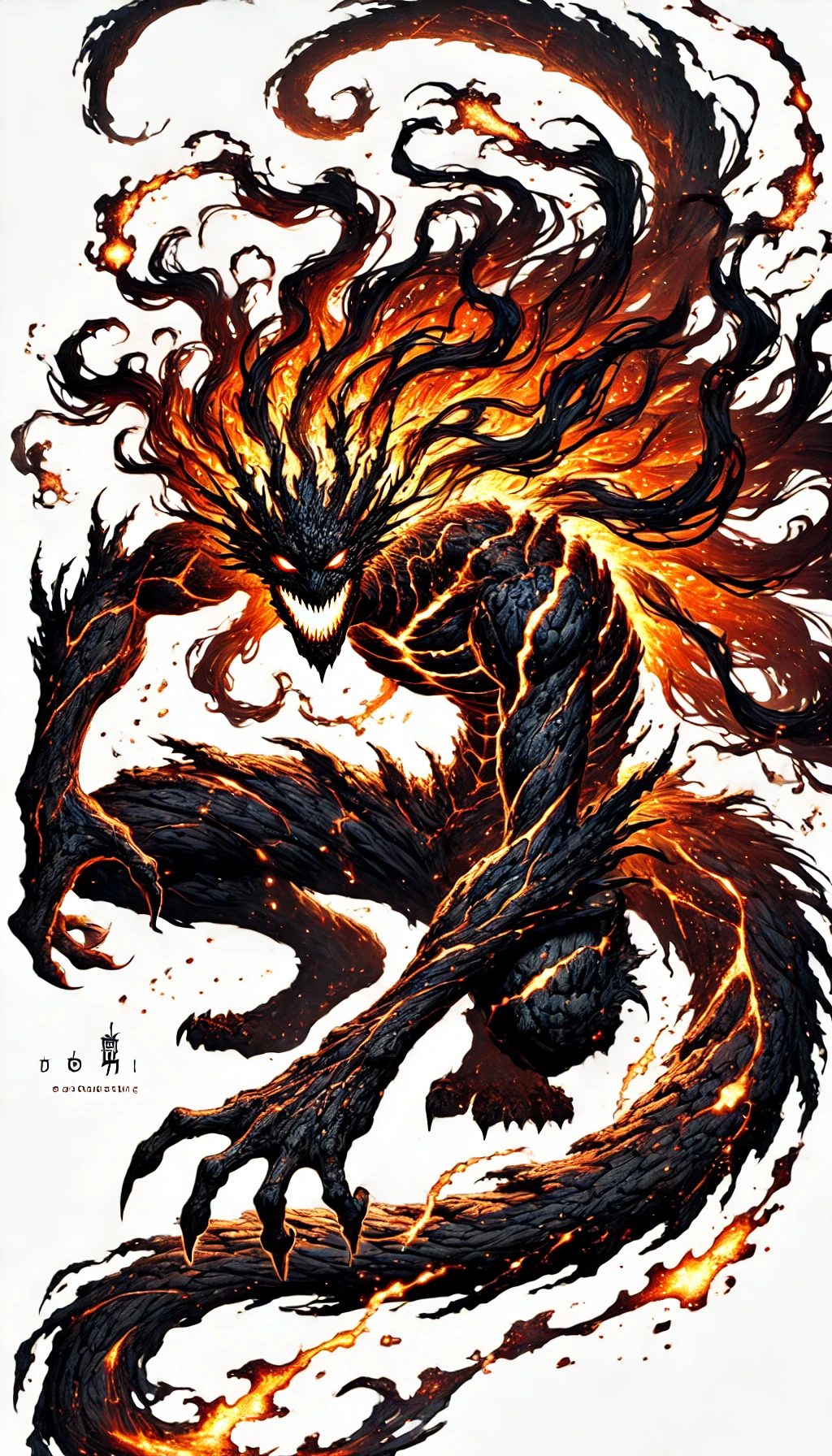
Hodophis is depicted as a fearsome, elemental figure, perfectly embodying the raw, untamed spirit of adventure and survival. His form is a dynamic, ever-changing blend of molten rock and flickering flames, constantly shifting and crackling with primal energy. His skin bears a dark, charcoal-like texture, etched with fiery cracks that glow intensely red, revealing the incandescent core that simmers beneath the surface.
His visage is bestial with sharp, predatory features that evoke a sense of ancient and wild power. His eyes blaze like twin coals, piercing through darkness with an intense, fiery gaze that can ignite fear and respect in equal measure. Powerful, muscular limbs end in sharp, talon-like claws, capable of rending stone and metal alike. A long, serpentine tail whips behind him, tipped with a spade of smoldering rock that leaves embers trailing in its wake.
Hodophis’s mane and eyebrows are composed of ever-burning flames, adding to his intimidating appearance. The heat radiating from his body can be felt from a distance, warming the air around him and occasionally bursting into small flares when he is angered or agitated. Despite his fearsome appearance, there is an undeniable allure to his presence, a magnetic pull that embodies the thrill of danger and the promise of epic tales.
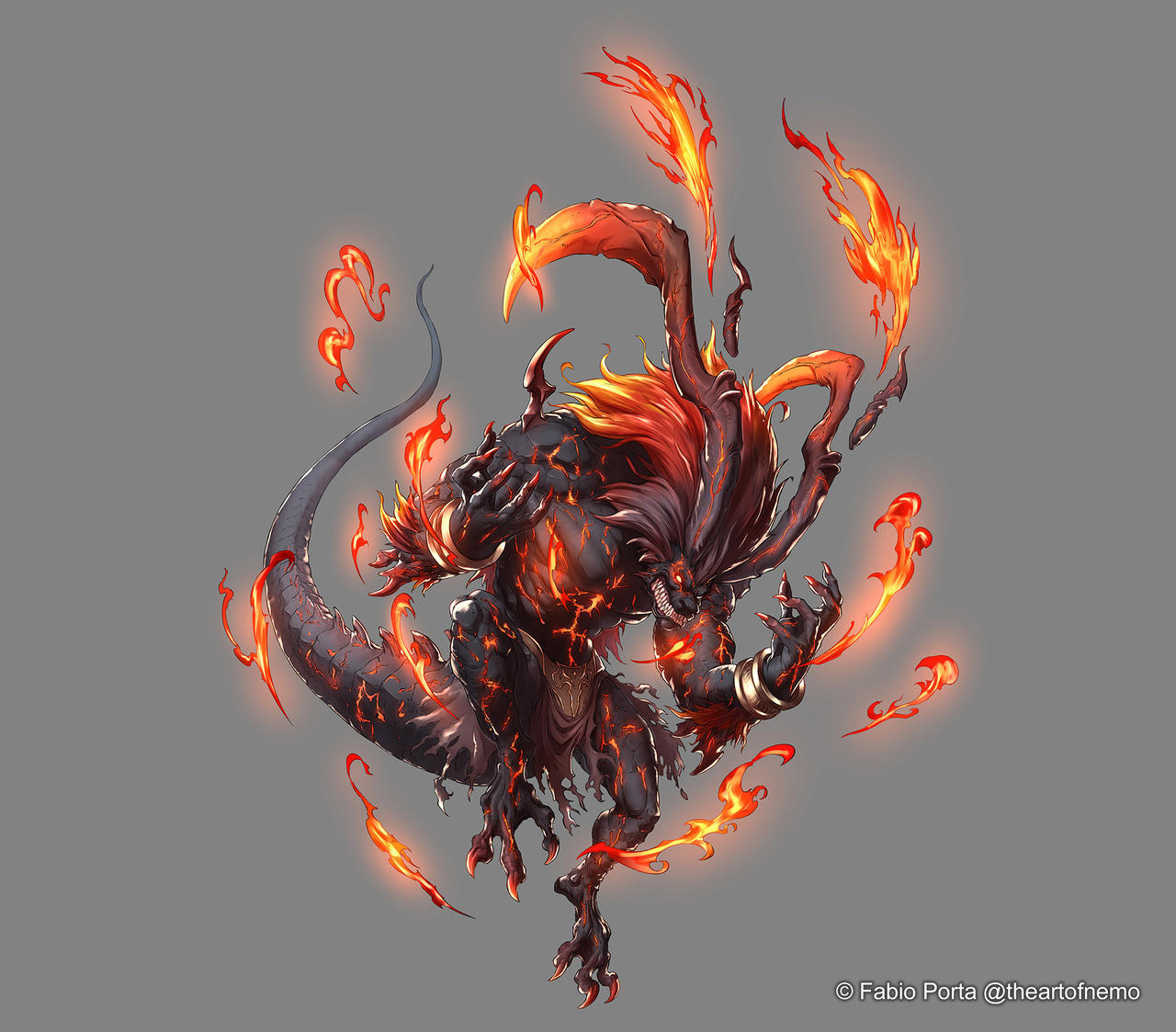
- Height: 242cm
- Weight: Variable
- Distinguishing Features: Everything, everything about this guy is distinguishing.
Personality
- Traits: Adventurous, Resilient, Impulsive
- Strengths: As the embodiment of survival and adventure, Hodophis is a master of exploration capable of thriving in even the harshest of environments.
- Weaknesses: His fiery nature can lead to unpredictable outbursts, and his restless spirit makes him unsuited for settings that require calm and deliberation.
- Goals and Motivations: Driven by a passion for adventure, Hodophis seeks to encourage exploration and self-reliance among mortals and gods alike, while also striving to preserve and protect the natural wilds of the world.
Relationships
Family:
- Lasair: Mother. The bond between Hodophis and Lasair was once profoundly strong, rooted in a deep mutual respect for the elemental force of fire that they both wield. However, after a significant falling out whose details are whispered in hushed tones among the gods, their relationship cooled considerably. While Hodophis continues to respect Lasair’s domain and her contributions to the primordial forces, he remains distant, engaging with her with a blend of deference and detachment, his true feelings about her kept closely guarded.
- Etnake: Sister. Hodophis harbors a complex blend of admiration and apprehension towards Etnake, recognizing her as a powerful embodiment of their elemental lineage. Her unpredictable and explosive nature both intrigues and alarms him, making their interactions a careful dance around her mood swings. Despite this, he views her as an essential ally and a formidable force within the pantheon, representing the raw power of fire in its most unbridled form.
- Oikos: Sister. His relationship with Oikos contrasts sharply with his ties to Etnake. Oikos, embodying the nurturing warmth of fire, draws out Hodophis’s protective instincts. He cherishes her compassionate nature and her dedication to safeguarding the weak, though he sometimes wishes she would embrace more of the adventurous spirit he holds dear. Nevertheless, he supports her unconditionally, proud of her ability to showcase the gentler side of their fiery heritage.
Rivals/Enemies:
- Ooscie: Hodophis bears a deep and instinctive resentment toward Ooscie, whose ancient feud with their mother Lasair shaped the fiery god’s very birth. Though the conflict between Fire and Water has cooled over the ages, Hodophis still views Ooscie and her progeny as ancestral rivals
- Kakurcia: Hodophis shares a friendly yet spirited rivalry with Kakurcia, the God of the Hunt. Both deities represent the thrill of the wild and the call of adventure, and their domains often overlap in the hearts of mortals. Hodophis admires Kakurcia’s cunning and fearlessness but often mocks him for his reliance on precision and patience over daring and instinct.
- Poraal Oir: Of all his rivals, Poraal Oir draws Hodophis’s deepest ire. He sees in Poraal too much of Gaoth Oir’s reckless cunning and self-interest—a spirit that seeks discovery not for survival or growth, but for dominance.
Attitude towards Mortals:
Hodophis holds mortals in high regard, seeing in them the same spark of daring and determination that defines his own essence. He delights in the courage of explorers, wanderers, and outcasts—those who brave the unknown not out of greed, but out of a burning desire to see what lies beyond the horizon.
To such mortals, Hodophis is both protector and provocateur. He watches over them in the wilderness, guiding their steps through instinct and intuition rather than direct intervention. Yet he is equally known to test his followers, engineering moments of peril to remind them that strength and self-reliance are forged in adversity.
Mythology and Worship
- Creation Myth:
In the times when humanity had yet to venture to all corners of the world, Lasair, Primordial of Fire, presided over Western Kair’Thear, a vast and verdant land blanketed by a dense forest that rivaled even the mighty Vahshi Forest. Here, Lasair was a tireless mother figure, nurturing the flora and fauna with a fervent passion and delighting in the bustling lives of the mortal creatures that called these woods home.
During these serene times, Lasair formed deep bonds with two of the forest’s most formidable guardians: a proud dire wolf alpha known for his cunning and bravery, and a wise mother bear, revered as the protector of the forest. Together, they kept watch over their domain, ensuring harmony and safety within the dense woodlands.
However, peace was shattered when Ooscie, the Primordial of Water, driven by jealousy of Lasair’s flourishing realm, launched a sudden and devastating attack. Colossal waves lashed the coasts, and the rivers ran dry. In a fiery burst of anger and retaliation, Lasair unleashed her might upon the land she once tenderly cared for, inadvertently setting the forest ablaze. The fire raged uncontrollably, consuming everything in its path and reducing the once-lush forest to ashes.
When the flames finally subsided and Lasair’s fury cooled, she returned to survey the damage. Heartbroken by the destruction and the loss of life, she frantically searched the charred remains for any sign of survival. Amidst the devastation, she found her two trusted companions, the dire wolf and the mother bear, both grievously injured and on the brink of death.
Moved by profound sorrow and remorse, Lasair sought to undo the harm she had caused. Drawing upon her divine essence, she bestowed upon each a spark of her fiery power, transforming them into deities. The dire wolf was reborn as Hodophis, embodying the spirit of adventure, survival, and the eternal flame of the campfire that brings warmth and light to the darkest nights. The mother bear became Oikos, symbolizing the warmth and security of the hearth, embodying the resilience and nurturing protection of domestic life that restores and sustains families after times of hardship.
Hodophis and Oikos rose from the ashes with new purpose and divine roles. Hodophis, now known as the Wanderer, became a beacon for all who venture into the wild, guiding adventurers and survivalists with his indomitable spirit. His domain became the wilderness itself, where every campfire serves as a reminder of his presence and protection.
- Major Cults and Religious Practices: Few mortals devote themselves solely to Hodophis, those that do are known as the Wayfarers, a wandering fellowship of monotheistic devotees. They travel constantly, guided by instinct and the faint pull of the divine flame that burns within their hearts. Outside this wandering order, many cultures pay homage to Hodophis through ritual offerings made before journeys or great endeavors. These offerings vary greatly between peoples: a trail of burning incense left at a crossroads, a flask of oil poured onto a campfire before setting out, or burning a portion of their rations before departure.
- Festivals: Among the Tabaxi, the Festival of the Burning Path is among their most sacred celebrations. Held at the close of the great seasonal Gathering, it marks the moment when the gatherers part ways to wander Staterum once more.
- Clergy and Temples: To Hodophis, permanence is stagnation. The notion of a grand temple devoted solely to him is anthema—a cage built from comfort and stone. Instead, his followers erect Waystones and Trailmarkers along the roads and wilds of Staterum: small cairns of rock, etched with spirals or the symbol of a flame encircled by stones. These humble markers serve as places of reflection, rest, and renewal for travelers who come across them. Rather than priests, Hodophis’s faithful often take the form of Wander-Chaplains—lone nomads, storytellers, or survivalists who carry his teachings from fire to fire. They offer blessings to travelers, heal the lost, and offer guidance to those lost.
Significant Historical Impact
- Major Plot Points in World History:
- The Scouring of the Dahri Empire: Hodophis is among the gods most closely associated with the bloody conclusion of the Age of War. As the endless conflict escalated beyond mortal control, the gods themselves could no longer remain idle observers. It was Hodophis and Alber, who led the flanking attack that broke the back of the Dahri Empire. While the empire’s armies fought desperately on the eastern front, Hodophis and Agra emerged from the depths of the Vahshi Forest. Together they laid waste to the Dahri heartlands—cities turned to smoldering ruins, their proud monuments swallowed by molten stone and flame. Faced with annihilation, the empire had no choice but to surrender, bringing the age-long war to a brutal end. Yet the devastation they wrought did not go unnoticed. Even among their divine kin, the horror of their unchecked wrath rippled through the heavens. Hodophis’s actions, became a cornerstone of divine reckoning and a direct catalyst for the creation of the Divine Accord, limiting the gods from ever again intervening so directly in mortal conflicts.
- The Clash of Themus Valley: In the shadowed years of the Age of Darkness, Hodophis faced one of his greatest trials. In the burning valleys of Eastern Kair’Thear, he confronted Spatalos. Their battle raged across mountains and plains, fire against decay, until the land itself split and molten rivers poured forth. Though Hodophis looked set to triumph, his victory was denied by the intervention of Paysius and Voluptia, whose combined might easily turned the tide. Overwhelmed and grievously wounded, Hodophis tore open a rift between realms and fled to the Plane of Fire, where he remains—a restless exile awaiting the day when the mortal world dares once more to call upon his flame.
- Artifacts:
- The Wanderers Flame: A divine torch, the Wanderers Flame never extinguishes, even when submerged or buried in ash, and its light reveals paths unseen by mortal eyes, ever guiding its bearers towards their goal.
Quotes
“The path is only lost to those who stop walking.”
Background
The Vindri
Across the open plains of the Windswept Marches, the Vindri people honor Hodophis and his sister Oikos as ever-present spirits in their daily lives. During the day, when the wind carries dust and sun in equal measure, they invoke Hodophis to guide their wandering herds and protect them from the unseen perils of the vast horizon. His presence is the courage in the traveler’s heart—the promise that every road has purpose.
At night, as the plains cool and campfires flicker against the endless dark, their prayers turn to Oikos, the Hearth Mother, who guards their makeshift camps and shelters their children beneath her warmth. Together, the Divine Siblings embody the eternal rhythm of the Vindri’s nomadic life—the bold stride into the unknown and the quiet return to the firelight that sustains it.
The Tabaxi:
To the Tabaxi, Hodophis is known as Esh’Kara, The Parting Flame. Though born of and forever loyal to Skoteinos, they have woven Hodophis deeply into their cultural fabric. To them, he is not merely a god of survival, but the divine Guide of Discovery, the flickering torch that leads their kind through the endless web of roads and stories that bind the world.
Every journey undertaken by a Tabaxi—whether to uncover a forgotten ruin, to seek a tale untold, or to trace the whispers of an ancient secret—is believed to begin beneath Esh’Kara’s watchful flame. In their eyes, he illuminates not only the paths of the living but the hidden trails between souls, ensuring that the great tapestry of stories woven for Skoteinos never frays or fades. Among the Tabaxi, Esh’Kara stands second only to Skoteinos himself; without him, they say, the roads between all peoples would vanish into shadow.
The Lone Wolf Pack Guild:
Among the Lone Wolf Pack Guild, Hodophis shares a revered yet distinct role alongside Kakurcia, the God of the Hunt. Among the guilds many divides, there exists one between the Hunters, who embody Kakurcia’s precision and mastery of the wild, and the Wanderers, who walk Hodophis’s path.
Those who follow Hodophis reject the notion of dominion or mastery over nature. They carry no maps, claim no territory, and measure no path twice. Instead, they let the forest itself guide them—trusting in instinct, in flame, and in the god’s whispered pull through the undergrowth. To these followers, the wilds are not something to be conquered or charted, but a living reflection of Hodophis’s creed: that survival, not control, is the truest form of understanding.