[mer-see-oh]
Basic Information
- Name: Mercio
- Domain: Commerce, Trade, Wealth
- Title: The Merchant King, The Golden Hand
- Alignment: Lawful Excess
- Symbol: A coin bag, with several coins spilling out
- Primary Worship Area: Agroma,
Physical Description
- Appearance:
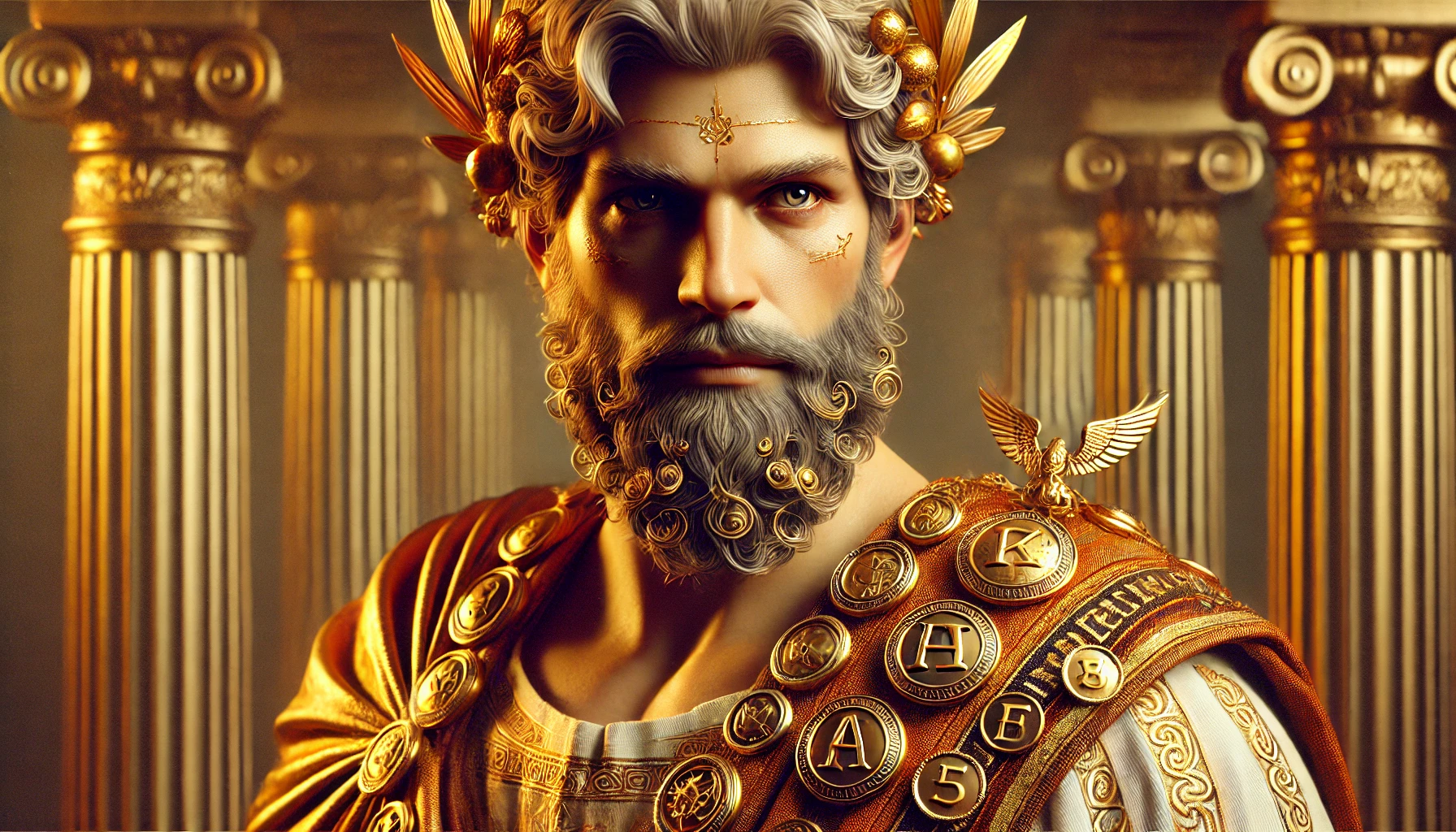
Mercio is depicted garbed in opulent attire that commands respect and admiration: richly woven fabrics in shades of deep gold and vibrant earth tones, each fold shimmering with a subtle glow of prosperity. His robes are meticulously adorned with intricate patterns of commerce symbols—coins, scales, and cornucopias—each detail crafted to signify abundance and success.
His face bears a sharp, calculating expression, with keen eyes that seem to assess the value of all they behold. These eyes, a deep, burnished gold, gleam with the acumen of a seasoned trader, reflecting his innate ability to navigate the complex world of trade and negotiation. His hair is neatly styled, silver streaks lending him an air of distinguished authority, while a well-groomed beard frames his jawline, adding to his regal and commanding presence.
Around his neck hangs a heavy golden chain from which dangles a medallion embossed with the symbol of a merchant’s scale, on his fingers, rings embedded with various precious stones sparkle, each gem representing different facets of wealth and commerce. Mercio’s overall demeanor is one of unyielding confidence and sharp wit, making him both revered and respected among gods and mortals alike.
- Height: 190cm
- Weight: 102kg
- Distinguishing Features: Gold streaks through his beard. Opulent clothing, decorated with gold trinkets.
Personality
- Traits: Calculating, pragmatic, influential
- Strengths: Excellent at negotiation and fostering prosperity, ensuring fair and profitable dealings
- Weaknesses: His focus on wealth and trade can sometimes make him seem cold or greedy to those who do not share his values.
- Goals and Motivations: To expand commerce and ensure that trade flows freely and fairly across the world, increasing the wealth and prosperity of his followers.
Relationships
Family:
- Ratura: Mercio finds Ratura’s whimsical nature tiring and her chiding demeanor somewhat tedious. Her propensity for creativity and the arts, though vital to the cultural richness of Staterum, contrasts sharply with his more structured approach to order and prosperity. As a result, he prefers to keep his interactions with her to a minimum, often avoiding her unless necessary.
- Vilcren: Mercio holds a substantial respect for Vilcren, recognizing the critical role her domain of agriculture and growth plays in sustaining prosperity across Staterum. He views her as a dependable ally and often seeks her out not only for strategic partnerships but also as a confidante, making her one of the few deities he trusts enough to unburden his worries upon.
- Biran: Adoptive Father. Mercio harbors great respect for Biran, who played a pivotal role in his upbringing and divine ascent. As his adoptive father and mentor, Biran’s influence is deeply ingrained in Mercio’s principles and approach to his domain. He attributes much of his understanding of commerce and governance to Biran’s guidance. Like most Mercio speaks highly of Biran, holding him in high esteem.
Rivals/Enemies:
- Spatalos: Spatalos represents everything Mercio stands against. Mercio despises Spatalos for promoting wasteful excess and preventing sustainable prosperity. He has witnessed too many potential benefactors of society succumb to Spatalos’s temptations, losing sight of long-term goals for immediate gratification, inevitably leading to ruin.
- Listunos: On the opposite spectrum but equally despised, Listunos, is another thorn in Mercio’s side. Mercio views Listunos’s influence as a perversion of the principles of commerce and trade. Where Mercio advocates for fair trade and the wise accumulation of wealth, Listunos encourages hoarding and deceit, undermining the integrity of economic systems and corroding the moral fabric of societies. Mercio believes that without compassion and honor, the very foundations of commerce crumble, leading to societal decay.
Attitude towards Mortals: Mercio maintains a complex relationship with mortals. Having once been mortal himself, he holds a deep appreciation for their industrious nature and their capacity for trade and commerce. His divine role has provided him a broader perspective on wealth and its effects, leading him to sometimes view mortals with a mix of admiration and condescension.
Mythology and Worship
- Creation Myth:
In the nascent days of Staterum, as humans ventured far and wide, exploring and settling new territories, the city of Vitaurum emerged as a bustling center of human activity. Yet, despite its rapid growth, the city faced significant challenges. The primitive systems of trade and barter that had served the early settlers were proving inadequate to support the burgeoning population, leading to widespread poverty and inequality.
Within the struggling city was born a boy named Mercio, orphaned at a tender age. Growing up in the streets of Vitaurum, Mercio quickly learned to navigate the complexities of urban life. His natural intelligence and keen observation skills allowed him to understand the intricacies of the city’s economy and the hardships faced by its people.
Mercio, wise beyond his years, saw that the city’s survival depended on a more sophisticated system of trade. With a brilliant mind for innovation, he began to develop concepts that would revolutionize commerce. He introduced the idea of standardized coinage, which facilitated easier and more equitable trade. He also established fundamental principles of economics, such as supply and demand, investment, and resource management, laying the groundwork for a thriving economy.
His innovations proved transformative for Vitaurum, turning the tide of poverty into prosperity. Mercio’s work caught the attention of King Biran, the ruler of Vitaurum, who was deeply impressed by the young man’s intellect and vision. In recognition of his contributions, Biran adopted Mercio into the royal family, giving him the resources and influence to implement his ideas on a grand scale.
Together, Mercio and Biran propelled Vitaurum and its surrounding regions into a period of unprecedented growth and stability. Mercio’s reputation as a visionary thinker and a champion of the people grew, and his methods were soon adopted throughout Staterum.
In gratitude for his monumental contributions to human society, King Biran brought Mercio to the sacred peak of Mon Olympus to meet Statera. Impressed by his wisdom and the significant impact of his work, Statera saw in Mercio the embodiment of progress and prosperity. She offered him a place among the gods, recognizing that his talents could benefit all of Staterum.
Mercio ascended to divinity, taking his place in the pantheon as the god of commerce and trade. His divine realm became a beacon of innovation and economic thought, guiding humanity in their endeavors of trade and prosperity. Mercio, once a clever child of the streets, now watches over the markets and merchants of Staterum, ensuring that fairness and ingenuity continue to drive the world’s economies.
- Major Cults and Religious Practices: Mercio is worshipped primarily by the financially elite, merchants, and anyone involved in commerce. His followers believe that proper homage to Mercio can bring prosperity and protect against financial ruin. His worship often involves rituals that symbolize wealth and success, such as offering gold coins and precious commodities at his shrines. This act has become a sign of wealth and power, with followers working to outcompete with what they are able to offer up to Mercio.
- Festivals:
- Festival of Scales: This major annual festival aligns with the close of Autumn, a time when merchants across the region calculate their earnings from the busy trade seasons leading into the more subdued winter months. The week is filled with parades, music, and opulent celebrations, with attendees encouraged to wear golden attire, symbolizing the wealth and success accumulated throughout the year. Originally a showcase for the affluent to flaunt their prosperity, the Festival of Scales has paradoxically become a favorite among the less wealthy as well. For them, it offers a rare opportunity to partake in the extravagances usually reserved for the rich, enjoying the lavish food, entertainment, and festivities funded by the upper echelons of society.
- Clergy and Temples: Mercio’s clergy are often drawn from the ranks of successful merchants and financiers, serving not only as religious leaders but also as advisors in economic matters. They wear robes embroidered with golden threads and symbols of commerce like scales and coins. While most of the temples dedicated to the Ascended Gods are shared temples dedicated to all three, Mercio does have his own dedicated and opulent temples, often found in major cities and places of wealth.
Significant Historical Impact
- Major Plot Points in World History:
- Mercio’s most enduring legacy is the establishment of the current commerce system that prevails across Siar’Morrin. Recognizing the need for a standardized and efficient method of trade among the rapidly expanding populations and diverse cultures of Staterum, Mercio devised a system that integrated various forms of trade, currency exchange, and market regulation. This system not only facilitated smoother transactions but also contributed to unprecedented economic growth and stability across the region.
- Mercio’s other great achievement was the founding of Ploutos, a city that once stood as a bustling hub of trade at the crossroads between the Biranian and Dahri empires. Known as the wealthiest city of its era, Ploutos symbolized the pinnacle of trade and economic prosperity. However, this city has been lost to time, now romoured to lie somewhere within the borders of The Western Scar.
- Artifacts:
- Chrysostom’s Coin: This seemingly ordinary gold coin is embossed with the intricate symbol of Mercio. The coin possesses the fabled ability, turning any base metal it touches into pure gold.
Quotes
”Give a man a fish, and you’re a poor salesman, never give commodities away for free. Fool.”
Cultural Reverence
In Agroma, the worship of Mercio is ingrained into the very stones of the market squares. Merchant guilds and trading houses view him not merely as a patron, but as a foundational architect of their prosperity. The city’s famous merchant families claim direct spiritual lineage to Mercio’s teachings, upholding codes of fair trade, strategic alliances, and measured ambition. His principles are taught alongside reading and arithmetic, and every child of the merchant class learns to offer their first earned coin at one of his many gilded shrines.
The Dahri Empire
To the rulers of the Dahri Empire, Mercio is a dangerous idol. They respect his skill and influence but disdain his worship among the merchant classes, viewing it as encouraging disloyalty to the state and a rise of individual power over imperial control. Propaganda often paints Mercio as a cunning manipulator who would erode the natural hierarchies of society if left unchecked — a whispering threat more potent than any open rebellion.